
 Posts
Posts


Six days have passed, six inconsequential days. On the eight day (the first of the six days), I managed to write about 500 words. Afterwards, no progress has been made. My right knee is sore and my achilles tendons are hurting as well. The muscle pain hasn't gone away completely.
I had reduced smoking, almost to one or two a day; but that too has increased. Yesterday, I smoked seven. I have been missing my cross-training as well.
I have serious doubts about my writing capability. I am experiencing too many mood swings, and those who know me don't know what to make of my varied moods. I feel low most of the times, experiencing euphoria once in a while, which, strangely doesn't translate into anything.
I am losing the grip.
Tuesday, May 19, 2009


Thursday, May 14, 2009
Uneasy lies the turban

He is probably the only Lok Sabha candidate whose mobile phone got stolen. But it’s something else that bothers Qamar Rabbani Chechi.
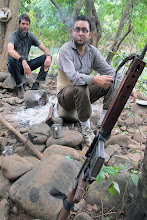
Pic: Ruhani Kaur
“Sorry, but that phone got stolen.”
Hardev Singh is apologetic about the trouble we have had to face in contacting Qamar Rabbani Chechi. Two days before, I had spoken to Chechi over his mobile phone.
“It would feel great to meet a fellow Kashmiri in a faraway place like Rajasthan,” he had told me then. Two days later, I try calling him over the same number, the moment I approach Dausa town, along with my colleague, Ruhani. The phone is switched off. Asking for Chechi’s election office in Dausa could be tricky, I know. And I am not wrong. Sitting on his haunches, with a hookah in his hand, the man who I asked directions to Chechi’s election office almost explodes. “Chechi, Pechi hum nahi jaante,” he says. My guess is correct. The man is from the rival Meena community.
Finally after contacting a friend who works in a local newspaper, I get hold of Chechi’s man, Hardev Singh, who tells me that Chechi’s phone had actually got stolen a day before during a public meeting. “If you really ask me, I am happy that I lost that phone,” Chechi told me later, as he wiped sweat from his brow. “I am not much of a politician, you see,” he smiled.
In Dausa, the electoral war is not between two political parties. It is a war which two rival castes are fighting. Dausa used to be a stronghold of the late Congress leader, Rajesh Pilot, a Gujjar. After his death, his son would win the seat in the last elections. But post-delimitation, the seat got reserved for Scheduled Tribe (ST) candidates.
“The Gujjars couldn’t see themselves being ruled by Meenas,” says Hardev Singh. So the Gujjar leadership got hold of Qamar Rabbani Chechi, who is a Muslim Gujjar from far-flung Rajouri district of Jammu and Kashmir. There, the Gujjars have ST status.
“Dev Narayan Bhagwan ki jai.” A group of Gujjar men have assembled at Khedla village, where Chechi is to address them. Chechi also raises his hands with others in invoking the Gujjar diety. That is not something which bothers him as a Muslim. What troubles him is the heat.
That afternoon, there are heat storms, and the temperature is above 40 degree Celsius. Back home, in Rajouri, it is less than half of that.
Just before I managed to catch hold of his new number, Chechi says he almost collapsed due to exhaustion. But this is Lok sabha election. And that means real hard work. More so, when your rival is a former minister in the the erstwhile Vasundhra Raje government, who then switched sides to Congress, and is now fighting independently after being denied a ticket by the Congress. Chechi’s main rival is Kirori Mal Meena, a veteran leader of his community.
“Kirori Mal is campaigning in a helicopter, but it is eventually Chechi sahab who is going to win,” says Subash Sharma, who has accompanied us from Chechi’s election office to Khedla. The support of other castes like the Brahmins is crucial for Chechi. Among the 13 lakh voters of Dausa, about 3 lakh are Meenas, while there are 2 lakh Gujjars. Brahmins have about the same votes while the Muslim votes are about 75 thousand. Sharma says all Brahmin voters will vote for Chechi because they want to thwart a Meena coming to power in Dausa. Sharma has begun to address me as “Sharma ji” after he repeatedly asked me my Gotra, and I reluctantly told him, and it turned out to be same as his. So I was “Sharma ji” now. “Same to same,” as he put it.
Chechi arrives in Khedla in a Tata Sumo, crammed between his supporters and a policeman. He is donning a traditional Rajasthani turban which he is visibly uncomfortable with. “You will have to vote for me to end ‘terrorism’,” Chechi tells the Gujjar Men, referring to the Meena ‘high-handedness.’ The men nod their heads in agreement. The smell of tobacco hangs thick in the heat – almost every man is either smoking a hookah or a beedi.
After a while I notice no one is listening to him. The men are all staring at Ruhani, whose eye is set on her lens. Nevertheless, Chechi goes on. “There are too many marriages on the voting day. But, please, makes sure you vote,” he tells them. “Otherwise not even a dog will care about us,” shouts Hardev Singh.
“My fighting elections from Rajasthan is an ode to secularism,” Chechi tells me, while sitting in our car, and after he has polished off a bottle of mineral water. “ Some people say that India only loves the land of Kashmir and not its people. But my candidature has proven them wrong,” he says.
But what about the heat? Chechi takes another swig from another bottle. “AC tez karo, bhai,” he tells our driver, and then turns towards me. “You know, in Rajouri, the moment the temperature touches 35-36, it rains. But here, there is no escape from heat,” he says while adjusting his turban.
Before addressing another meeting, Chechi makes a stopover at his house. He drinks more water, and takes off his turban for a while, closing his eyes under a whirling fan. He also changes his clothes before he leaves. “Do you mind if I sit in your car?” he asks, “you are coming with me, no?” We are.
At the next meeting, a group of boys are sitting on a parapet. Chechi looks at them, greeting them with a nod. “Cylinder dilwa dena jab jeetoge,” they shout. (Chechi’s election symbol is a gas cylinder).
It’s now time to make appearance at a community marriage of Saini caste. The phone keeps on ringing. “Ram Ram,” Chechi greets every caller. In between there is a call. It is from Rajouri. “Wale-Kum-As-Salam,” Chechi breaks into a grin.
For once, he looks relieved.
(This report first appeared in Open magazine)
Wednesday, May 13, 2009
Day 6 & 7
Two days just passed by. I spent time in office, working on small news items. There is this muscular pain I have had to endure. At home, I would lay motionless, almost all the time, somewhere between the spheres of sleep and daze. I read quite a bit, particularly Nirmal Verma.
But for two days I could write nothing. I tried forcing myself into it.
I just couldn't do it.
But for two days I could write nothing. I tried forcing myself into it.
I just couldn't do it.
Monday, May 11, 2009
Day 3, 4 and 5
I am glad to report that the last three days have been quite productive.
On Day 3, I began making the change in the story plot, writing 334 words. On Day 4, I wrote about 500 words. That midnight, I got up and saw a full moon smiling at me from the window. I went out on to the balcony, lit a cigarette, and just sat there. The feeling was awesome.
On Day 5, that is on Sunday, I wrote another 500.
On Day 3, I began making the change in the story plot, writing 334 words. On Day 4, I wrote about 500 words. That midnight, I got up and saw a full moon smiling at me from the window. I went out on to the balcony, lit a cigarette, and just sat there. The feeling was awesome.
On Day 5, that is on Sunday, I wrote another 500.
Friday, May 08, 2009
Day 2
Day 2: 239 words input. Constipated writing, like that of a teenager writing for his school magazine. Whole day spent in predicting election results over cigarettes and coffee.
Day 3 has almost gone by. Have written nothing so far. If I do, you'll hear from me, tomorrow.
Day 3 has almost gone by. Have written nothing so far. If I do, you'll hear from me, tomorrow.
Thursday, May 07, 2009
Day 1
From May 6 till December 31, I have 240 days to finish writing my novel. Yesterday I didn't write anything. I woke up in the morning in a flooded house - the sink tap had been left open, and there was some blockage in the drain, and the water gushed out, innundating two rooms. I had to clear it all.
I was in office by afternoon, and I had to write two small opinion pieces for the coming issue. In between two colleagues coaxed me into joining them for lunch at a restaurant in Defence Colony.
I returned to office and could not write. But a day before, I had a very engaging conversation with my friend Neelesh Misra, and he suggested some changes in the plot, which made sense to me. The thing I like about Neelesh is that he makes me see clearly through the haze of foolish, sentimental day-dreaming (which, incidentally, he himself does all the time).
In the evening I worked out at my gym, and sweated so much that I had to immediately drink two bottles of Gatorade. On my way home, I bought some chicken, and then spent the entire evening marinating it in curd, and then cooking it in a paste of home-made tomato, onion and garlic. Then I poured myself a drink, sat in my room, with a notebook open in my lap.
Now I have only 239 days left. Actually 238, since today is half over, and I have only written 60 words at around 10 a.m.
I was in office by afternoon, and I had to write two small opinion pieces for the coming issue. In between two colleagues coaxed me into joining them for lunch at a restaurant in Defence Colony.
I returned to office and could not write. But a day before, I had a very engaging conversation with my friend Neelesh Misra, and he suggested some changes in the plot, which made sense to me. The thing I like about Neelesh is that he makes me see clearly through the haze of foolish, sentimental day-dreaming (which, incidentally, he himself does all the time).
In the evening I worked out at my gym, and sweated so much that I had to immediately drink two bottles of Gatorade. On my way home, I bought some chicken, and then spent the entire evening marinating it in curd, and then cooking it in a paste of home-made tomato, onion and garlic. Then I poured myself a drink, sat in my room, with a notebook open in my lap.
Now I have only 239 days left. Actually 238, since today is half over, and I have only written 60 words at around 10 a.m.
Tuesday, May 05, 2009
Last Post
I have seriously started working on The Last Man from Kashmir.
Dear readers, as the municipality says on the good, old roads: Kindly bear with us (me in this case).
I have decided that till the time I don't finish writing it all, I won't write anything on my blog (Remember No Optional Striving message on my pin-up board at office?) But, yes, I shall update this post daily and tell you what progress I have made on the novel.
From May 1 onwards, I have written over 1,600 words. They badly need editing, but right now, that is not my concern. My priority is to sit and write daily. Yes, daily, no matter what happens.
So, through this post, I shall update you, dear readers, daily, on how much I have written further. By December 31, it should be done. Otherwise I will quit writing, and, then I will only write insipid pieces of journalism.
Tell me, are you with me on this?
Dear readers, as the municipality says on the good, old roads: Kindly bear with us (me in this case).
I have decided that till the time I don't finish writing it all, I won't write anything on my blog (Remember No Optional Striving message on my pin-up board at office?) But, yes, I shall update this post daily and tell you what progress I have made on the novel.
From May 1 onwards, I have written over 1,600 words. They badly need editing, but right now, that is not my concern. My priority is to sit and write daily. Yes, daily, no matter what happens.
So, through this post, I shall update you, dear readers, daily, on how much I have written further. By December 31, it should be done. Otherwise I will quit writing, and, then I will only write insipid pieces of journalism.
Tell me, are you with me on this?
Friday, April 24, 2009
Shock Therapy
Probably by now you are tired of this: I have not been writing again.
On my work station, I have pinned up stuff, which I thought would prod me into clobbering my keypad every day: A September 1, 1952 cover of Life magazine, with Hemingway on it. The issue carries his entire novel, The Old Man and the Sea.
Then there are these two messages which are supposed to have been put by writer Philip Roth on his desk: Stay Put, No optional striving. There is also a poem from Dushyant Kumar, and an old picture from rural Kashmir.
But nothing has worked. The moment I sit at my desk, my hands turn limp, and lead gets filled into my arms and head. I feel sleepy as well.
I open a blank file on my desktop, and stare at the cursor, thinking of how to push through the debris of stillness. After a point of time, I give up. I go out, light a cigarette, and exchange words with colleagues. When I come back, Hemingway is looking grimly at me. I evade his stare.
It’s like this: I need to finish writing The Last Man from Kashmir. I have the story which I need to pour out in words.
Last night, I finished reading Sylvia Plath’s Bell Jar. I wonder: do I need shock therapy, too?
On my work station, I have pinned up stuff, which I thought would prod me into clobbering my keypad every day: A September 1, 1952 cover of Life magazine, with Hemingway on it. The issue carries his entire novel, The Old Man and the Sea.
Then there are these two messages which are supposed to have been put by writer Philip Roth on his desk: Stay Put, No optional striving. There is also a poem from Dushyant Kumar, and an old picture from rural Kashmir.
But nothing has worked. The moment I sit at my desk, my hands turn limp, and lead gets filled into my arms and head. I feel sleepy as well.
I open a blank file on my desktop, and stare at the cursor, thinking of how to push through the debris of stillness. After a point of time, I give up. I go out, light a cigarette, and exchange words with colleagues. When I come back, Hemingway is looking grimly at me. I evade his stare.
It’s like this: I need to finish writing The Last Man from Kashmir. I have the story which I need to pour out in words.
Last night, I finished reading Sylvia Plath’s Bell Jar. I wonder: do I need shock therapy, too?
Friday, April 17, 2009
Gandhigiri in Kashmir
The people of a tiny village in north Kashmir have won a small but decisive battle against the army, the first such example in twenty years of conflict.
The 15,000 residents of Bomai are not leaving their houses now, something they had threatened to do. There is word that three soldiers of the army’s Rashtriya Rifles will have to face disciplinary action for what happened in Bomai on February 21. The army camp, which was set up here in 1997, next to the girl’s high school, has also been shifted. There have been no incidents of stone pelting; no slogans have been raised in favour of Pakistan. In fact, during the agitation, the people of Bomai did not allow any politician from the mainstream or the separatist camp to set foot in their village. What the villagers have achieved could serve as an eye opener for everyone in the trouble-torn state, more so for the hard-line separatists.
It all began on the evening of February 21, when army soldiers from the local camp fired at three men near the main entrance of the village. Mohammed Amin Tantray (23) and Javid Ahmed (20) died due to bullet injuries while Nazir Ahmed was seriously injured. The locals say that it was a cold-blooded murder. A senior police source, however, termed it as a “genuine mistake”. It so transpired that there was a scuffle between two groups of youth at a local festival. When the army approached the men, who were coming back from the festival, they thought that they were being stopped by their rival group. Instead of stopping, they began to run away. The armymen should have exercised restraint. But, in a conflict zone like Kashmir, nobody wants to take chances. The soldiers fired at the men, resulting in two deaths.

Tantray’s elder brother, Mohammed Sultan, who is a post-graduate in mathematics, and teaches at the high school, remembers not feeling well that evening as a friend of his urged him to have another cup of the salty Kashmiri tea. And then the call came. Sultan rushed to the site, took his bleeding brother to the hospital, where he was declared brought dead. “I still can’t believe that he is gone. With his death, my father’s back bone has broken,” Sultan said. Sultan’s father sat next to him, silently shedding tears over the loss of his youngest son.
(Pic: Mohammed Sultan with other grieving members of his family)
The people were furious. It was not only the case of two men dying. The army camp where the soldiers fled to after the firing had been an eyesore for many years. The soldiers had erected bunkers on the wall along the school. They had made holes in the wall from where exhaust pipes jutted out, sending smoke inside the classrooms. Sumayya, a student recalls that some of the soldiers would shine mirrors at the girls, and make obscene gestures as well. After the deaths in the village, the villagers decided that enough was enough.
The same night the Bomai residents formed a coordination committee which spearheaded the agitation. “We were very clear that we won’t allow any separatist leader to hijack our issue,” says Hakimul Rahman Sultani, the head of the people’s committee. The villagers launched a peaceful movement, threatening at one time to vacate the entire village en masse if the army camp was not removed. There was not a single incident of violence during the agitation which lasted for thirteen days.
Ultimately, the authorities had to bow down. It also helped that a young chief minister had just taken over, who took up the issue with New Delhi. “But he could only pursue the case because the agitation was entirely non-violent and apolitical,” says a local observer.
The battle has been won. But the residents of Bomai are gearing up for other things as well. “We still haven’t been informed officially about the status of the inquiry or the quantum of punishment meted out to those responsible for the killing,” says Sultani. The villagers are also hoping that apart from the shifting of the army camp, other things in the village would move as well. “We will now push for the development of our village through the people’s committee,” says Ghulam Hassan Shah, a local resident.
For the families who lost their young members, there is little to cheer about. Tantray’s young niece, Anika trots around the house, searching for her. The elders know she won’t be able to see him ever. Tantray’s brother, Mohammed Sultan sits, along with other teaching staff, in the ground of the school. He has taken up to smoking heavily. “I think almost five packets a day,” he smiles sadly.
 It is recess time, and a cricket match is going on between two classes. A girl hits the ball hard, and another, who like everyone else wears a headscarf, rushes after the ball. She picks it up near the wall where the bunkers once stood, managing to save a boundary.
It is a victory for cricket, if not anything else.
(An edited version of this story first appeared in Open Magazine - Page 22, 23. Click on http://openthemagazine.com/)
The 15,000 residents of Bomai are not leaving their houses now, something they had threatened to do. There is word that three soldiers of the army’s Rashtriya Rifles will have to face disciplinary action for what happened in Bomai on February 21. The army camp, which was set up here in 1997, next to the girl’s high school, has also been shifted. There have been no incidents of stone pelting; no slogans have been raised in favour of Pakistan. In fact, during the agitation, the people of Bomai did not allow any politician from the mainstream or the separatist camp to set foot in their village. What the villagers have achieved could serve as an eye opener for everyone in the trouble-torn state, more so for the hard-line separatists.
It all began on the evening of February 21, when army soldiers from the local camp fired at three men near the main entrance of the village. Mohammed Amin Tantray (23) and Javid Ahmed (20) died due to bullet injuries while Nazir Ahmed was seriously injured. The locals say that it was a cold-blooded murder. A senior police source, however, termed it as a “genuine mistake”. It so transpired that there was a scuffle between two groups of youth at a local festival. When the army approached the men, who were coming back from the festival, they thought that they were being stopped by their rival group. Instead of stopping, they began to run away. The armymen should have exercised restraint. But, in a conflict zone like Kashmir, nobody wants to take chances. The soldiers fired at the men, resulting in two deaths.

Tantray’s elder brother, Mohammed Sultan, who is a post-graduate in mathematics, and teaches at the high school, remembers not feeling well that evening as a friend of his urged him to have another cup of the salty Kashmiri tea. And then the call came. Sultan rushed to the site, took his bleeding brother to the hospital, where he was declared brought dead. “I still can’t believe that he is gone. With his death, my father’s back bone has broken,” Sultan said. Sultan’s father sat next to him, silently shedding tears over the loss of his youngest son.
(Pic: Mohammed Sultan with other grieving members of his family)
The people were furious. It was not only the case of two men dying. The army camp where the soldiers fled to after the firing had been an eyesore for many years. The soldiers had erected bunkers on the wall along the school. They had made holes in the wall from where exhaust pipes jutted out, sending smoke inside the classrooms. Sumayya, a student recalls that some of the soldiers would shine mirrors at the girls, and make obscene gestures as well. After the deaths in the village, the villagers decided that enough was enough.
The same night the Bomai residents formed a coordination committee which spearheaded the agitation. “We were very clear that we won’t allow any separatist leader to hijack our issue,” says Hakimul Rahman Sultani, the head of the people’s committee. The villagers launched a peaceful movement, threatening at one time to vacate the entire village en masse if the army camp was not removed. There was not a single incident of violence during the agitation which lasted for thirteen days.
Ultimately, the authorities had to bow down. It also helped that a young chief minister had just taken over, who took up the issue with New Delhi. “But he could only pursue the case because the agitation was entirely non-violent and apolitical,” says a local observer.
The battle has been won. But the residents of Bomai are gearing up for other things as well. “We still haven’t been informed officially about the status of the inquiry or the quantum of punishment meted out to those responsible for the killing,” says Sultani. The villagers are also hoping that apart from the shifting of the army camp, other things in the village would move as well. “We will now push for the development of our village through the people’s committee,” says Ghulam Hassan Shah, a local resident.
For the families who lost their young members, there is little to cheer about. Tantray’s young niece, Anika trots around the house, searching for her. The elders know she won’t be able to see him ever. Tantray’s brother, Mohammed Sultan sits, along with other teaching staff, in the ground of the school. He has taken up to smoking heavily. “I think almost five packets a day,” he smiles sadly.
 It is recess time, and a cricket match is going on between two classes. A girl hits the ball hard, and another, who like everyone else wears a headscarf, rushes after the ball. She picks it up near the wall where the bunkers once stood, managing to save a boundary.
It is a victory for cricket, if not anything else.
(An edited version of this story first appeared in Open Magazine - Page 22, 23. Click on http://openthemagazine.com/)
Wednesday, April 08, 2009

Friday, March 27, 2009


Monday, March 23, 2009
Hypergraphia

I long for Hypergraphia. I am tired of explaining my mood swings to others, and justifying it to myself. I am tired of everything. I am tired of reading. I am tired of drinking. I am tired of behaving normally. I am tired of being social. I am tired of remaining awake. I am tired of falling asleep.
The right knee is hurting again. That means I cannot run. Two nights ago, I was feeling terribly lonely. I sent smses to five people, asking them for a hug. One replied. The other replied the next day. One sent a blank sms back. And two didn’t reply at all. Hugs are premium, and people attach all kinds of meanings to them. Even hugs are not free. They are tagged, bound by cardinal rules of societal norms, used as a tool for barter by people. I don’t want them anymore.
Will be travelling tomorrow. Need to get out of this wretched city for few days. It is better to be among strangers in a stranger city. The people there don’t know you. They have no expectations. They will leave you alone. Even when there is a conversation, there will be no background to it.
I hate backgrounds, too.
I want to do this: flee to the mountains. Cook a nice meal. Lie down on a haystack in sunshine. Listen to Agha Shahid Ali reciting his poetry. Converse with the old postman. Put my head under a brook. Light a pipe. Play with mud.
Write feverishly, in long hand.
Hypergraphia.
Thursday, March 19, 2009
Just another day
Today has also passed by. I got up in the morning, and went for a run around the neighbourhood track. While I was at it, five airplanes flew overhead. I wondered who was in them and where all did they arrive from or were going to. Then I sat for a while on a broken bench. At my feet lay two empty bottles of mineral water and an empty packet of potato chips. Someone must have had something to rejoice for or feel sorry about. Or he must have been drinking just like that, just like me.
At ten I went to a dentist friend who has taken up the task of ridding me of all dental ailments. He injected some local anesthesia, and suddenly my right cheek and a portion of tongue went numb. He then drilled into a tooth and filled it with what tastes like white cement (I think). He then offered me a nice cup of tea, and we talked for long about retirement plans and back-strengthening exercises.
Then I went to office, and read a few newspapers, edited an article, and checked few websites. I also browsed through my e-mail. Then I had a few spoons of rice with potatoes, politely declining a colleague’s offer of sharing a mutton Biryani.
Towards evening, I went to my favourite bookshop, and bought three books. Then I went to a café which I used to frequent earlier with a beloved, who I think still loves me but is no longer mine. I declined many offers of the girl at the counter to have coffees laced with chocolate and ice-cream. Instead, I had my usual cold coffee sans any embellishments. Something open up within, and I wrote furiously for about forty minutes. Then I experienced hot flushes and started to shake.
At first I thought it was due to a strong dose of caffeine. Then I thought I was having a heart attack. I thought of calling a few friends who I knew were drinking beer at a nearby pub. But then more than fifteen minutes passed and I was still alive, and I could still hold a pen between my fingers.
The feeling still hasn’t gone completely as I write this, and it is already midnight. I intend to resume reading Turgenev’s Fathers and Sons after this. The Internet at home is not working. So, I shall be posting this in the morning from my office.
If you are reading this, that means I am still around.
I haven’t had a drink since five days. I think it’s just withdrawal symptoms.
Or may be I have just grown old.
At ten I went to a dentist friend who has taken up the task of ridding me of all dental ailments. He injected some local anesthesia, and suddenly my right cheek and a portion of tongue went numb. He then drilled into a tooth and filled it with what tastes like white cement (I think). He then offered me a nice cup of tea, and we talked for long about retirement plans and back-strengthening exercises.
Then I went to office, and read a few newspapers, edited an article, and checked few websites. I also browsed through my e-mail. Then I had a few spoons of rice with potatoes, politely declining a colleague’s offer of sharing a mutton Biryani.
Towards evening, I went to my favourite bookshop, and bought three books. Then I went to a café which I used to frequent earlier with a beloved, who I think still loves me but is no longer mine. I declined many offers of the girl at the counter to have coffees laced with chocolate and ice-cream. Instead, I had my usual cold coffee sans any embellishments. Something open up within, and I wrote furiously for about forty minutes. Then I experienced hot flushes and started to shake.
At first I thought it was due to a strong dose of caffeine. Then I thought I was having a heart attack. I thought of calling a few friends who I knew were drinking beer at a nearby pub. But then more than fifteen minutes passed and I was still alive, and I could still hold a pen between my fingers.
The feeling still hasn’t gone completely as I write this, and it is already midnight. I intend to resume reading Turgenev’s Fathers and Sons after this. The Internet at home is not working. So, I shall be posting this in the morning from my office.
If you are reading this, that means I am still around.
I haven’t had a drink since five days. I think it’s just withdrawal symptoms.
Or may be I have just grown old.
Tuesday, February 24, 2009
Lovers like that

The city sleeps like an old man with blocked sinuses. In deep slumber it seems to rise, monster like, producing sinewy sound. That is when he gets up, and in the darkness, he sits in the balcony, taking care to hide himself from the drunk watchmen who assemble every now and then outside his house, making lewd comments about women. A marriage party is passing somewhere nearby, and there is a distinct sound of a brass band playing old filmi songs. One of them is about a lover beseeching the breeze to shower flowers over his beloved.
He has been a lover himself; he realises what it does to men – this thing called love. He is turning old now. Days pass by, one by one, leaving wrinkled footsteps underneath his eye sockets. His back has given away, and his hands tremble with excitement or even without. And like the city, his sinuses are blocked, too.
An hour ago his friends have left. Friends who sell plastic and write poetry. Friends who are about to become parents. Friends who are diabetic. Friends who have witnessed neighbours killing neighbours. Friends who have too much alcohol and don’t speak a word. He juggles through them, his own poison in his hands, and a cigarette held between his lips. He sings for them, sometimes, when the music within him becomes overbearing. He sings for them when he cannot handle the love he has within himself.
In bhool bhullaiya galiyon mein
Apna bhi koi ek ghar hoga
Ambar pe khulengi khidkiyan
Khidki se khula ambar hoga…
And now they have left. There are empty glasses everywhere. The floor is strewn with food crumbs and cigarette ash. A phone charger hangs from a plug. The walls smell of perfume. There are shoe marks on the rug.
After they are gone, he just lies down on his back, in the middle of the room. He looks at the ceiling fan which badly needs dusting. He closes his eyes. Home. House. Here. There. He doesn’t belong anywhere. He just needs to love. But now, there is no one to be loved.
That is when he gets up, and in the darkness, he sits in the balcony. Thinking of love, flowers and old filmi songs. The city snores all around him.
Wednesday, January 28, 2009
Friday, January 23, 2009

Tuesday, January 20, 2009
The script, the plot

I wish you were here. Or I were there. Or both of us were somewhere. The high gardens of my imagination lie barren. I need to talk to you. About words. About restlessness. About fear. About an injury in my knee. About Frangipani. About the bright green tint of a Carlsberg beer bottle. About sleepiness.
The other day you came to the café. I spoke a little out of anxiety.
“Baat karne aaye ho kya?”
I looked at you, inside you. I went silent. You stirred your coffee. You cried silently. I later told someone that we had met. He enquired about you, wanting to know whether you were happy. With you one never knew, I told him. He nodded. He understood.
Happiness is not for us. We are seekers – of what lies ahead of happiness. Of what lies beneath it.
Frangipani can only exist in our imagination. The high gardens of our lives will stay barren.
That is the script; that is the plot.
Tuesday, December 30, 2008
Family Tree

I know nothing about my family beyond my great grandfather. My grandfather, who was a Sanskrit scholar, and who dabbled in astrology as well, died in the November of 1985. A day before he died, he had been shifted to a hospital. I remember my mother had come home in the evening after visiting him, and, in the night, as my father prepared to lay our beds, she advised him against it. “We won’t require them,” she said. True to her word, a little after midnight, the message came from the hospital. Grandfather had passed away in his sleep with my eldest uncle by his side.
I was too young then – a boy, who would turn ten coming February. And I had no inclination towards knowing about my ancestors. It was only after my grandmother’s death in 2003 that my ignorance turned into a void. I had just returned from Baghdad after covering the war for a news channel. I remember looking at my ailing grandmother, who lay in her bed, her breath running up and down her chest like a squirrel.
The next morning, I left for Benares. The same night, she passed away.
I remember feeling nothing about it after I had kept down the phone. Death, no matter whose it is, leaves my father shaken. I remember offering to return immediately even when I didn’t really mean it. Father, I suppose, didn’t want to ruin my trip.
“Don’t worry, I’ll manage,” he said, while trying to hold back, in vain, his anxiety.
I didn’t turn up for the cremation. After I returned, two days later, I remember sitting at the spot where my grandmother had breathed her last. Still, I felt nothing.
A year later, I began researching for my novel, set around the 1947 tribesmen attack on Kashmir. My maternal uncle – a boy of ten in 1947 – was in the north Kashmir town of Baramulla when the tribesmen came in buses, entering through the border town of Uri and plundering it. Baramulla came next.
One muggy evening, in June 2004, my maternal uncle and I sat on a sofa, in the backdrop of a noisy air-conditioner.
And then he began telling me about his life.
It was till dawn that he told me about those days – on how, along with the Mahura power station, their lives were plunged into darkness. The conversation – one way most of the time – continued for almost a week. He returned to Jammu, where he lives in a one-bedroom flat, nursing his diabetic wife, after their only son was dragged out of the bus by terrorists, in 1997, and shot dead. I kept on asking him, over phone from Delhi, and in person whenever I visited Jammu or when he revisited us, till a complete picture of the family from my mother’s side was evolved.
A majority of those memories forms the basis of my novel.
In the past five years or so, I have made many enquiries about my paternal side. Most of the knowledge I have acquired doesn’t go beyond my grandfather. My youngest uncle, who in his youth has experimented with writing and theatre, and who retired last year from active government service, blames his two elder brothers for lack of interest. He says he was too young when his father and mother could have spoken about the family. I don’t completely buy that argument but I can’t blame him or his two elder brothers. All of them spent their lives – first in establishing themselves in their respective positions and saving money for the construction and, later, the renovation of the house they painstakingly built in what was then a Srinagar suburb, and then dealing with the post-exile trauma in much part of the 1990s, after driven out of the valley.
Today, all I know about my great grandfather is that he was named after the preserver in the Hindu trinity – Lord Vishnu. He was fond of opium and became a widower shortly after my grandfather was born. In fact, I have learnt that after my grandfather was born, he fell seriously ill. His distraught mother – my great grandmother, is believed to have prayed to the God to spare his life and instead take hers.
The same day, she passed away. A day later, my grandfather’s condition improved considerably, and he lived up to his mid seventies. So, whole my grandfather spent his life in the service of the language of the Gods, his father lay dazed in Opium smoke, flirting with married women in the neighbourhood. He had many lovers, and spent most of his time reciting Kashmiri poetry to them.
As a young man, when I would write passionate letters to the women I fell in love with (which was quite often), my father would sometimes discover them, and then remark that I was a reincarnation of my great grandfather.
I am sure he must have also suspected me of experimenting with Opium.
I have two New Year resolutions. One, I strive to write every day. Two, I will visit the holy city of Haridwar and get a family tree made.
I better learn more about a man called Vishnu.
May be I could learn a trick or two about love as well.
Tuesday, November 18, 2008
Yet another
The response to my Hindi poems has been so poor that I have been contemplating blog suicide. But before I do that, here is another:
तुम्हारे उजले तलवों से दिन निकल आया है
मेरे स्याह माथे पर रात अभी लहराई है
मेरे सीने की नदी में पाँव डालकर देखो
इसकी कितनी गहराई है
I invite readers to share their own poems - in Hindi and English, which has
mention of sole(s), the bottom of the foot.
तुम्हारे उजले तलवों से दिन निकल आया है
मेरे स्याह माथे पर रात अभी लहराई है
मेरे सीने की नदी में पाँव डालकर देखो
इसकी कितनी गहराई है
I invite readers to share their own poems - in Hindi and English, which has
mention of sole(s), the bottom of the foot.
Tuesday, November 11, 2008
For Maya
First, my apologies. It has taken me a while to post some of my poems even after receiving many responses. Actually I had been travelling again, with no access to the Internet. Anyway, here they are, four of them. I hope you like them. Do let me know.
Also, one clarification: though I am a fan of Gulzar, the name Maya is not inspired by the usage of the name in some of his films. Maya is my muse, an imaginary seductress who visited Vincent Van Gogh in his delirium (Please do read Irving Stone's magnificent biography of Van Gogh, Lust for Life, and you will know what I mean).
Thank you.
अकेलेपन का शोर अलग होता है
वो कानों में नही बजता
वो बजता है मन की मुंडेरों पर
संगीतबद्ध होने से बचता
उसे सुनकर बच्चे पीछे नही लगते
न ही गेहूँ बीनती औरतें
सर उठाकर देखती है
काले तवे सा बस वो चपटा होता है
जिसपर आँखें समय सेंकती है
और...
स्मृति पथराये बिस्तर पर
करवट-करवट रेंगती है
सिन्धु सी आवाज़ करता वो
तो मैं भी सिंह सा गरजता
पर...
अकेलेपन का शोर अलग होता है
वो कानों में नही बजता
***
मेरी हथेलियों पर
लकीरें नही
तुम्हारे आने-जाने के
निशान हैं
***
जब शाम घिर आती है
तो क्या
मेरे बारे में सोचती हो?
उस सरफिरे बाज़ार में
आँखें घुमाकर
क्या मुझे खोजती हो?
जब मैं नही दिखता तो
क्या कंधे भारी हो जाते हैं?
या काफ़ी के प्याले में
घड़ियाल नज़र आते हैं?
***
कानपुर से लौट आई हो
सूटकेस में
खांसी भर लायी हो
"क्या कर रही हो?"
"खों खों... अनपैक"
जी करता है
तुम्हारे गाल पर
विक्स में चुपडी हथेली से
एक थप्पड़ रसीद दूँ.
(CROSS POSTED HERE)
Also, one clarification: though I am a fan of Gulzar, the name Maya is not inspired by the usage of the name in some of his films. Maya is my muse, an imaginary seductress who visited Vincent Van Gogh in his delirium (Please do read Irving Stone's magnificent biography of Van Gogh, Lust for Life, and you will know what I mean).
Thank you.
अकेलेपन का शोर अलग होता है
वो कानों में नही बजता
वो बजता है मन की मुंडेरों पर
संगीतबद्ध होने से बचता
उसे सुनकर बच्चे पीछे नही लगते
न ही गेहूँ बीनती औरतें
सर उठाकर देखती है
काले तवे सा बस वो चपटा होता है
जिसपर आँखें समय सेंकती है
और...
स्मृति पथराये बिस्तर पर
करवट-करवट रेंगती है
सिन्धु सी आवाज़ करता वो
तो मैं भी सिंह सा गरजता
पर...
अकेलेपन का शोर अलग होता है
वो कानों में नही बजता
***
मेरी हथेलियों पर
लकीरें नही
तुम्हारे आने-जाने के
निशान हैं
***
जब शाम घिर आती है
तो क्या
मेरे बारे में सोचती हो?
उस सरफिरे बाज़ार में
आँखें घुमाकर
क्या मुझे खोजती हो?
जब मैं नही दिखता तो
क्या कंधे भारी हो जाते हैं?
या काफ़ी के प्याले में
घड़ियाल नज़र आते हैं?
***
कानपुर से लौट आई हो
सूटकेस में
खांसी भर लायी हो
"क्या कर रही हो?"
"खों खों... अनपैक"
जी करता है
तुम्हारे गाल पर
विक्स में चुपडी हथेली से
एक थप्पड़ रसीद दूँ.
(CROSS POSTED HERE)
Subscribe to:
Posts (Atom)