I remember, one day
While sitting
Just like that
You made on
A pack of cigarettes
Kept on my table
A sketch of a plant
Come and see it now
A flower has apppeared on it
~
Translated from Gulzar's Koi Baat Chale...

 Posts
Posts
 I am travelling on the Golden Quadrilateral, one of the last symbols of the Vajpayee Government. Till few years ago, huge pictures of the former Prime Minister would don toll plazas built at various spots on the super highway. The pictures are gone but you can still find traces of the NDA era. At such one place on the National Highway 8, I meet Rajpal.
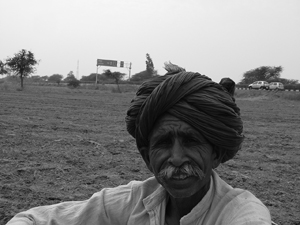 I move on. Just before Kotputli, on the Jaipur highway, I enter a field where a turbaned man is sitting on the earth, a flute resting beside him. There are goats grazing nearby. His back is turned against me and so he is almost startled as I greet him. I tell him I have come from Delhi and would like to ask him few questions. His name is Raja Ram and he is 60 years old. He has been a farmer all his life. He has never been to Delhi or Jaipur. He lives nearby and has no electricity in his house. He has never heard of Sachin Tendulkar. “Who is Abdul Kalam?,” I ask him. “He was a fakir,” he replies. “What is your wish list for 2007?” He looks at me as I put this question to him and then looks at his goats. “Nothing,” he replies.
 Further ahead, I meet Ratan Lal, a young boy, who studies in 8th class in a government school. His village, Chapakhedi is a few kilometers away from the highway, which goes on to Mumbai. He wants to join Army when he grows up. Has he ever seen a computer? “No,” he replies almost apologetically, “but I have heard about it,” he asserts. “What is it?” “It is an electronic pigeon, used for sending messages,” he answers. What does he want in 2007? “I wish I could see a cricket match on television,” he says.
 “The upper caste men would object to this, maintaining that we had no right to sit on a cot,” he says. Last year, some of the boys of his caste, along with a few social activists began a ‘khaat andolan.’ They would take out cots from their houses and sit on them outside. Some of them were beaten up by drunken upper caste men. “They also declared a social boycott against us,” remembers Ram Lal. But still, he says, only 50 percent lower castes are with them. “The rest of them still prefer a non-confrontationist approach,” he says as he sits on a cot outside his house for a photo op.
 A few kilometers before Udaipur is Idra gram panchayat, where 50 gypsy families have built small settlements. “We were tired of always being on the move and decided to settle here for the sake of the new generation,” says Banjara leader Bansilal. He laments that no politician pays heed to them since most of them do not vote. “We are always on the move, searching for jobs. If someone is working in Gujarat, how is he supposed to spend 500 rupees and come here for voting?,” he says. What is his expectation from 2007? “The Police harass us a lot here. I wish that could change,” Bansilal says, urging me to have a cup of tea at his house.
 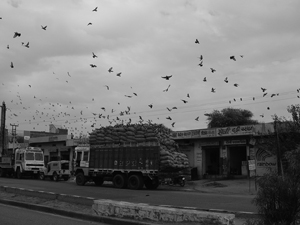 On my way back, I am reminded of my promise made to Rajpal. As the evening descends, I reach the spot where I had left him two days back. The shutter of the Feel Good wine shop is half open and in the dim light, I ask the owner about Rajpal. “He is holding his Panchayat behind this shop, in the fields. There is a turn there, you can go inside,” he says with an amused look on his face. And true to his words, I find Rajpal with his bottle, surrounded by a few men. He is regaling them with his stories.
 “This had been my family’s house for 42 years and there are not even stones left now,” says a bleary-eyed Dharmesh. His wife has shifted to her father’s house and Dharmesh and his father stay in a neighbour’s house.
 The village is home to 27 Bheel families, out of which 3 families live outside the village, by the river. After independence, the Government, recognizing the vulnerability of the Bheel tribe, allotted some land to the community in 1964 as a part of the land reforms. “Ever since we were allotted this land, the upper caste Rajput and Jat families in the village have had their eyes set upon this land,” says Gangaram Bheel, a village elder. The Bheel community members say that this particular stretch of land is very fertile and many times in the past, the upper caste landlords have offered them land elsewhere. But the Bheels refused to shift. “They destroyed our crops and even declared a social boycott but we did not part away with our land. How could we? We have nothing else,” says Dharmesh. In October this year, the plan to extend the old grovel road offered an opportunity to the landlords to grab the land belonging to Bheel tribals.
 The Bheels then approached the local administration including the Police and the SDM. The Police, according to the Bheels, accepted the complaint but took no action. The SDM, however, tried for a compromise between the two parties. “The sarpanch’s husband said that he will give land elsewhere to the displaced families. We told him to give it to us in writing,” says Bhanwarlal, another Bheel villager. That did not happen. What happened instead was something that the Bheels had been fearing for years.
 On December 6, a Bheel maha rally was organized in the village against the attack. On the same day, the upper caste landlords also organized a similar rally, alleging that the Bheels were trying to usurp their lands and were trying to vitiate the atmosphere at the behest of ‘outsiders’. Beeladi village is just a few kilometers inside from the super highway – also known as the Golden Quadrilateral project – that joins Delhi to Mumbai.
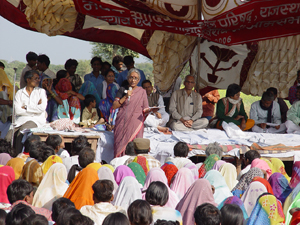 Noted social activist, Aruna Roy, who addressed the Bheel maha rally, demanding rights for the tribals, says, “Development has become an euphemism for grabbing the land of the poor and the downtrodden.”
 Ajmer Singh was caught in a viscious web of bonded labour after a farmer from his village employed him as contractual labourer for 12,000 rupees per annum. On less than 35 rupees a day, he worked seven days a week, for 12-14 hours every day. The day he was unable to come for work due to illness, the farmer would ask Ajmer Singh to pay a fine of 100 rupees. Within a year, he was also forced to take some loan from the farmer. Once caught in the debt trap, he was forced to work in the farmer’s fields for years, on a very low wage. “I worked day and night at his fields. Gradually, he asked me to bring my 15-year-old son along with me to work. There was not even a single hour of rest,” says Ajmer Singh. Three months ago, Ajmer Singh was lucky enough to be freed by labour activists. He earns 60-70 rupees a day now, working on a daily basis in farms. The minimum daily wage rate in Punjab is 97 rupees. But still Ajmer Singh is grateful for his recently-acquired freedom.
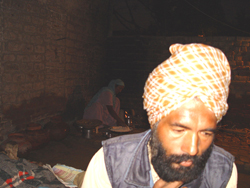 Janata Singh of Mansa’s Makha village was fed this drug regularly by his landlords. He worked day and night in their fields, while his wife worked worked at the landlord’s house. “They would give me a break of few hours on Gurupurab. For the rest of the time, throughout the year, I worked in a dazed state in their fields. I even slept in their fields,” says Janata Singh. “I would come home by midnight and by 4 am, they expected me back, for work in the cowsheds. I was deprived of sleep for years. I would fall asleep while cleaning the dung and then they hurled abuses at me,” says his wife.
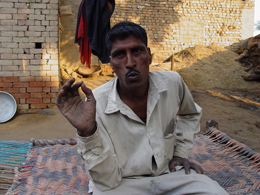 Kala Singh was also fed Bukki by his landlords, while making him work in their fields. One day, while spraying pesticide, he got poisoned by it and had to be hospitalized. Kala Singh alleges that this made his landlords so angry that they got him arrested by the Police in a case of theft. “My landlord came drunk to my house and beat me up, while the Police looked on,” says Kala Singh.
 All of them are lower castes. “We have told them that instead of fighting for Gurudwaras, they must fight for their own lot,” says Bhagwant Singh Samaon, a CPI-ML activist.
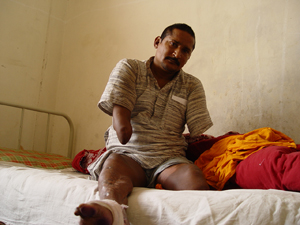 The news finally arrives in the village. For 3.5 hours, in front of the judge, Bant Singh narrated the sequence of the attack on him and identified his attackers. The final judgement of this case, as per Bant Singh’s lawyer, is expected by December 25.
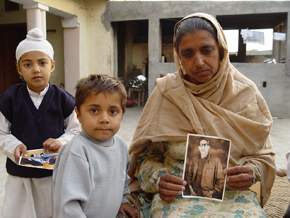 On a string cot, in front of her, sits Amrik Singh, whose two sons have also been arrested in the case. “It is all being done at the behest of the liberation guys (CPI-ML activists). They are trying to mobilize Dalits against us. They are poisoning their minds,” he says. Ask him about the attack and he goes silent for a while and then whispers, “ It is not an act against Dalits. It is a case of personal enemity. Bant Singh had a series of fights with our boys. And some of them hit him back.” How many of them? “Only four, I swear. Three of them are innocent. They have been dragged into this.” And does those four include his sons? Another bout of silence. And then another whisper. “Yes, my younger son.”
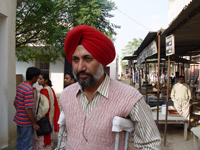 The labour activists staged a dharna outside the DC’s office in Mansa, demanding that the administration take action against the landlords. Finally, a day before the rally, the administration seized all the licensed weapons, thus nullifying the rally. “They are trying to create a Ranvir Sena in Punjab,” says Sukhdarshan Singh Natt, a veteran leftist (In red turban).
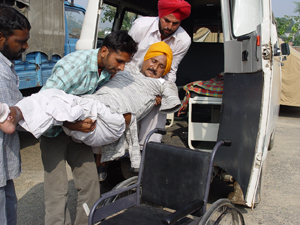 Nobody can swear this more than Bant Singh himself. “Being a lower caste, they expected me to keep to myself. But I would raise my voice everytime they committed any wrong. I got their ration depot cancelled and I was not even dependent on them since I raised pigs for a living instead of working in their fields. They did this to me in order to send a message. But it has boomeranged,” says Bant Singh, as he is being carried back to the hospital, from the court.
 “But it still continues in some villages; our men in villages are getting threats that they will be finished off,” says Kamaljeet Singh, a former Robotics engineer, who is now a CPI-ML full-timer (standing behind in maroon jacket with his fellow comrades).
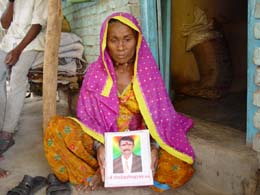
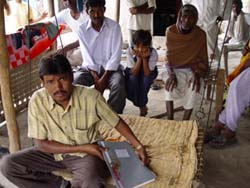
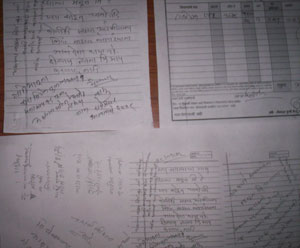 The number of farmers committing suicide in Vidarbha since June 2005 has risen upto 1,136. In November alone, this year, 91 farmers have committed suicide.
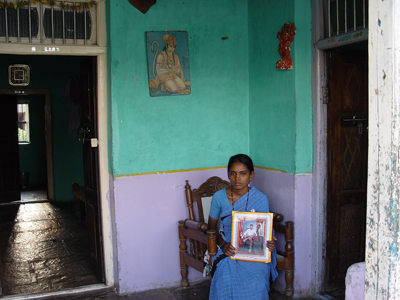
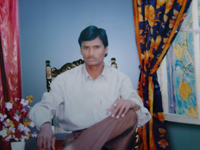
 I don't know how to continue living. I have taken a loan of 15,000 rupees. The Government says that the price of cotton will not be hiked. Since I have plunged into losses, I am ending my life. My mother and father should not be harrassed. Chief Minister, please give us the correct price for our cotton. Deputy CM, RR Patil, fix the rate at 3,000 rupees otherwise more suicides will happpen. Pratibha, please get remarried; I am sorry, I am leaving you alone.





 Posts
Posts