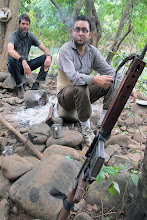
In his first ever interview, top Naxal leader Misir Besra tells me how a jackfruit tree led him to the Naxal movement.
 When the police party approached the car in which Misir Besra was travelling, he did not run away. The strategy was perfect since Besra’s photo had never appeared in the police records. And looking at his face and physique, no one would ever suspect him of being one of the most-wanted Naxalite leaders.
But this time, the police were not taking any chances.
Besra was detained and his photo circulated among jailed Naxalites. In no time, his men identified him. After all, Misir Besra alias Commander Sunirmal alias Bhaskar was no ordinary foot soldier. As a member of the CPI (Maoist)'s politburo and the Central Military Commission, Besra headed the Eastern Command, supervising the party’s activities in Orrisa, Chhattisgarh, Jharkhand, West Bengal and lower Assam. He was also the incharge of the Military Intelligence wing and helped the party procure arms and ammunition.
Besra was feeling cold when I met him in Jharkhand. This was his first ever interaction with the media. Upon being offered a cigarette, Besra politely refused saying he had quit smoking. “I had come to drink tea when the police came and picked me up,” he said with a smile on his face.
Besra has come a long way having spent 22 years in the jungle. While studying at a school in the Giridih district of then undivided Bihar, Besra says he witnessed a lot of discrimination against tribals. Later in 1985, as a student of Hindi Honours, he also showed keen interest in Political Science and read about the lives of revolutionaries such as Bhagat Singh and Khudiram Bose. “One day, I took mahua (local brewed liquor) to a shopkeeper and he refused to pay me. He asked me to run away or he would thrash me,” recalls Besra. Soon after this incident, an old jackfruit tree in his village was cut down by a few landlords. “They took away the branches but I decided that I would not let them take away the trunk,” says Besra. Along with a handful of friends, Besra guarded the trunk. “The Block Development Officer and the Tehsildar tried to convince me to let the affluent families take away the trunk but I did not budge,” he says.
According to Besra, this incident left an indelible mark on him. “Earlier, I was even influenced by Shibu Soren’s Jharkhand Mukti Morcha but soon it would appear to be a false movement to me,” says Besra.
In October 1985, a troupe of left-wing Akhil Bharatiya Krantikaari Sammelan came visiting Besra’s village. After listening to the revolutionary songs, Besra decided to join them. “I slipped away with them after the programme was over,” says Besra.
There was a time, Besra remembers, when the Naxalites were only in possession of a few double barrel guns. “Initially we were treated like dacoits by the villagers,” he says. But gradually things changed.
This was the time when disconnect between ‘Bharat’ and ‘India’ was widening. People in this area were increasingly getting discontented with New Delhi. People were increasingly going to bed with empty bellies. Healthcare and education were nonexistent. More than two decades later, nothing has changed in these parts of India.
Initially, the new recruits like Besra received training from the rebels of the People’s War Group (PWG), active in Andhra Pradesh. In 2004, PWG and the Maoist Communist centre (MCC), active in Bihar and Jharkhand, joined hands to form the CPI (Maoist).
According to Besra, many recruits leave after being inducted since they cannot handle the rigours of jungle. But most of them stay since this at least ensures that they get food to eat. Moreover, a gun in their hands also gives them a sense of empowerment.
During the 9th Congress of the party, held in Bhimbandh in Bihar, Misir Besra was the incharge of security. While returning back, his company raided a police picket in Lakhisarai district of Bihar, killing four police personnel. In 2004, Besra is said to have planned and executed an ambush in Baliba in Jharkhand’s West Singhbhum district in which 29 police personnel were killed.
In 2003, Besra met the chief of the CPI (Maoist), Muppala Laxmana Rao alias Ganapathi in Jharkhand. During interrogation, Besra told the police that Ganapathi dyes his hair. He keeps trimmed moustaches and sometimes shaves them off. Another top leader, Mallojula Kotheshwara Rao alias Prahallad is deaf and also suffers from severe health problems. Another top party functionary, Pramod Mishra, who is the incharge of Punjab, Haryana, New Delhi and J&K, is a fine sports person. Also, there is only one female member in the 17-member Central Committee. Her name is Anuradha Gandhi and she happens to be the wife of politburo member Koppad Gandhi, who is incharge of party documentation.
Besra says that the state committees of the CPI (Maoist) also exist in states like Delhi, Haryana and Punjab. “Without the participation of middle class, there will be no revolution,” says Besra. So how much success have they achieved in urban areas like Delhi? “Not much,” Besra confesses, “but our members are active there.” Besra’s admission is confirmed by the fact that recently Maoist literature and propaganda CDs were recovered in Haryana. In Delhi, an undercover Naxalite was arrested from Sangam Vihar in Delhi. An intelligence report by the Home Ministry states that Maoists are trying to engineer cast conflicts as a part of their strategy in states like Haryana. After the clash between the police and the workers of Honda factory in Gurgaon in 2005, a Honda showroom was attacked in Haryana’s Kaithal. The attack was led by Ravinder, a member of a left-wing organisation.
According to Besra’s interrogation report, Naxalites were also planning to target at least two police officers. One of them is H.J. Dora, former Director General of Andhra Pradesh Police, who lives in Delhi.
The Naxalite leadership is also looking for experts like Computer engineers. According to Besra, the Central Committee had asked for allotting a Chemist and an Electronic Engineer as well.
How does he spend time in jail? “I read a lot; I have just finished reading a novel by Agyey.
Is he in touch with his comrades? “No,” replies Besra in a matter-of-fact tone, “since I am under arrest they won’t trust me any more.”


 Posts
Posts